Berry Online

A blog for Dr. Brian Carroll's journalism classes at Berry College

21.9.06

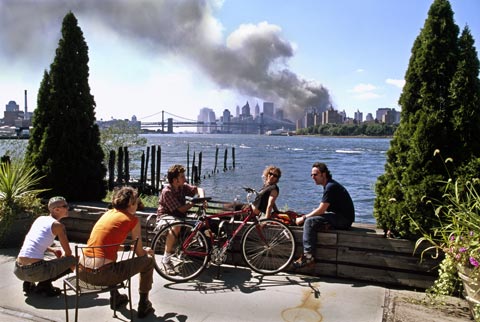
It's ME! in that photo

Yesterday, Slate posted this piece criticizing Frank Rich's New York Times column about the 9/11 photo shown here. The picture was taken by Magnum photographer Thomas Hoepker on the afternoon of 9/11. Calling the image "shocking," Rich suggested that the five New Yorkers were "relaxing" and were already "mov[ing] on" from the attacks. Slate's David Plotz disputed that characterization of the picture, arguing that the subjects had almost certainly gathered to discuss the attacks and to find solace in others' company. Rather than showing callousness, as Rich suggested, it depicted civic engagement. But since neither Rich nor Plotz knew exactly what the five New Yorkers in the photo were doing or thinking, we invited them to contact Slate and tell us.

Young New Yorkers on the Brooklyn waterfront on 9/11.

This morning, Slate received an e-mail from Walter Sipser, a Brooklyn artist who is the man on the far right of the photo. (How do we know? Sipser has confirmed his identity in several ways, most persuasively with current pictures of himself. Click here to see a blowup of the man in the photo next to pictures of Sipser taken today.) Here is what Sipser wrote:

A snapshot can make mourners attending a funeral look like they're having a party.

Thomas Hoepker took a photograph of my girlfriend and me sitting and talking with strangers against the backdrop of the smoking ruin of the World Trade Center on September 11th. Earlier, she and I had watched the buildings collapse from my rooftop in Brooklyn and had made our way down to the waterfront. The Williamsburg Bridge was filled with hundreds of people, covered in dust, helping one another make their way onto the street. It was clear that people who ordinarily would not have spoken two words to each other were suddenly bound together, which I suppose must be a fairly common occurrence in the aftermath of a catastrophe.

We were in a profound state of shock and disbelief, like everyone else we encountered that day. Thomas Hoepker did not ask permission to photograph us nor did he make any attempt to ascertain our state of mind before concluding five years later that, "It's possible they lost people and cared, but they were not stirred by it." Had Hoepker walked fifty feet over to introduce himself he would have discovered a bunch of New Yorkers in the middle of an animated discussion about what had just happened. He instead chose to publish the photograph that allowed him to draw the conclusions he wished to draw, conclusions that also led Frank Rich to write, "The young people in Mr. Hoepker's photo aren't necessarily callous. They're just American." A more honest conclusion might start by acknowledging just how easily a photograph can be manipulated, especially in the advancement of one's own biases or in the service of one's own career.

Still, it was nice being described as a young person. I was forty at the time the photograph was taken.

Addendum: On Wednesday evening, Slate received an e-mail from Chris Schiavo, who is the woman second from the right in the photo. (She titled her message: "From the contortionist sunbather.") Schiavo, who was Sipser's girlfriend at the time, has confirmed her identity with current photographs of herself. Schiavo writes:

I am one of the "disaffected sunbathing youth" in the photo. I think Walter Sipser and your readers have already voiced most of what should be considered when looking at this photo in conjunction with the New York Times article.

I am also a professional photographer and did not touch a camera that day. Why? For many reasons including a now-obvious one: This somewhat cynical expression of an assumed reality printed in the New York Times proves a good reason. (Shame on Mr. Rich and Mr. Hoepker—one should never assume.) But most of all to keep both hands free, just in case there was actually something I could do to alter this day or affect a life, to experience every nanosecond in every molecule of my body, rather than place a lens between myself and the moment. (Sounds pretty "callous," huh?) I also have a strict policy of never taking a photograph of a person without their permission or knowledge of my intent.

I am a third-generation native New Yorker, who knows and loves every square inch of this city, as did her ancestors before her. My mother and father are both architects and artists who have contributed much to the landscape of this city and my knowledge of the buildings that are my hometown and my childhood friends. (Ironically, my mother even worked for Minoru Yamasaki, the World Trade Center architect.) The point being, it was genetically impossible for me to be unaffected by this event.

15.9.06

The Seven Deadly Sins of Student Writers
By BEN YAGODA, in The Chronicle of Higher Education, Sept. 8 issue

I have been teaching college writing since 1992. The corrections I find myself making on student assignments fall into two general categories. The first concern problems of style — specifically, clarity and grace. So I mark the many places where my students commit wordiness, vagueness, awkwardness, banality, and so on. The other category is mistakes: usages that do not follow the accepted rules of standard English.

From the beginning, it was clear to me that most student mistakes fall into a small number of categories — seven, to be precise. They have common qualities that speak to unfortunate cultural trends, which I'll discuss in a minute. But first, the seven deadly sins. (The examples in quotation marks are from actual student writing assignments.)

1. Dangling modifiers. "Being the most spectacular event in the nation, newspapers were obligated to devote major coverage to the hurricane." "By reversing the color scheme, the eye is captured." "Claiming to be a simple man leading an ordinary life of a male as he enjoys watching football with his buddy's, Smith's lifestyle is far from ordinary." (For buddy's, see No. 6, below.) What makes these dangling modifiers (sorry if I seem to be stating the obvious) is that newspapers were not the most spectacular event; the eye doesn't reverse the color scheme; and Smith's lifestyle didn't claim to be a simple man.

An interesting thing about dangling modifiers is that a rather select group of students commits them: the minority who would even attempt a complex sentence. Another interesting thing is that, much more so than the other errors on my list, dangling modifiers show up in well-respected publications, such as The New Yorker ("Like a bad French movie, Jones's life began to intersect with [another person's].") and The New York Times Book Review ("rather than providing the meticulous examination of the process of looking ... , we are treated to rhetorical flights that provide little perspective of any useful kind").

2. Omitted commas. As the popularity of the book Eats, Shoots & Leaves: The Zero Tolerance Approach to Punctuation suggests, punctuation problems are endemic and, perhaps, epidemic. However, in my experience they are clustered in a few areas. One is the omission of a comma after an appositive or a parenthetical phrase. "All residents of Wilmington, Del. were issued paper bags in which to place their leaves"; "Prof. Jackson, who joined the faculty in 1978 is on sabbatical this year." My students usually leave out the comma after "Del." and "1978." Almost as common is neglecting the comma before an adverbial phrase, as in "The football team won yesterday ending a five-game losing streak."

3. Gratuitous commas. Let me count the ways. Students seem to reach for a comma whenever they feel any anxiety about a sentence's syntax, when they find themselves using an unfamiliar word, or when they take a breath: "Approximately, fifteen percent of the class are minority group members." "Smith described the concert as, 'a blast.'" "He shares a house with three, senior, pre-med students." "Class president, Joe Rockwell, presented the award." All the commas in those sentences need to go. A fairly new but very powerful trend is the insertion of a comma after "And," "But," or "Yet" when one of those is the first word in the sentence: "But, the president presented a different viewpoint."

Fifteen years ago, at the start of my full-time teaching career, I was most struck by the error of the comma splice —that is, the linking of clauses with a comma instead of a period, semicolon, or conjunction. For example: "He was not always this extreme, in fact he started out as a moderate." These are going stronger than ever; consistently, about a quarter of my students are habitual comma-splicers. Currently quite popular is the incorrect use of "however" as a conjunction roughly synonymous with "but": "The majority of students go away on spring break, however some stay at home."

4. Semicolons. I've learned to pretty much count on it: Virtually any time a student uses a semicolon, the use is wrong.

5. Use of the word "they." This is the one item on the list with shades of gray. A student wrote, "He asked each audience member to reconsider their stance," using the plural "their" to stand in for the singular "member." Before 1975 or so, standard usage dictated the use of "his" in this context and since then has respectfully requested "his or her." Many people (including me) try hard to avoid the choice by rewriting the sentence to something like: "All audience members need to reconsider their stance." The fact is, however, that the plural formulation has a long pedigree, including use by such authors as Jane Austen, Oscar Wilde, and Sting ("If you love someone, set them free"); is today used in speech by all but the prissiest prescriptivists; and has even been endorsed for writing by some respected authorities.

My own sense is that this usage isn't widely acceptable in prose yet, but it will be soon. The trouble with my students is twofold. First, they are quick to use "they" even when the gender of the antecedent isn't in question: "I talked to my friend, and they said they would get back to me." Second, students typically use "they" when referring to (singular) businesses, rock bands, sports teams, restaurants, and stores — in cases, that is, where "it" is clearly the appropriate pronoun. For example: "Every college has their trends." "The company has been working hard to reshape their image."

6. Spell-check errors. I came in on the first wave of spell-check utilities. They lull students and others into a false sense of security, leaving homonyms or near homonyms of the intended word unmarked. Cataloging this kind of mistake can be great sport; I treasure the article about a board-of-education meeting that mentioned the "Super Attendant of Schools," and the one on drug problems that referred to a "heroine attic."

If you stare at such mistakes long enough, some of these actually seem to make sense, as in "The storm wrecked [as opposed to wreaked] havoc." And some such errors are so inviting that they now outnumber correct usages, at least in my students' work. I expect to read that something peaked (rather than piqued) the interest, that a person poured (rather than pored) over a book, that an action lead (rather than led) to negative consequences. That's not even getting into all the homonymic apostrophe confusion described in Eats, Shoots & Leaves: who's/whose, it's/its, you're/your, buddy's/buddies.

7. Wrong word. The spell-check errors get the headlines and the laughs, but a more common and insidious problem is word choices that are off, sometimes by just a hair, sometimes by a Beatles wig and a full beard. Too often, reading student papers is like listening to a routine by Norm Crosby, the malapropeptic comedian who refers to having a good "rappaport" with a like-minded friend. Here are some real-life examples, with what I guess to be the right word in brackets:

"Of the many things the students aspired [expected] to see, a terrorist attack was not one of them."

"The drop in candidates can be accredited [attributed] to. ... "

"Stories about the hurricane invade [dominate] the entire first section of the newspaper."

"No one can blame [accuse] John Henrickson of being an apathetic college student."

"The vast proportion [majority] of students is enrolled in the College of Arts and Science."

Then there's this one, which seems to encapsulate all the problems students are having: "The land, which is currently occupied with [by] older, run down homes, will be rejuvenated [I'm not sure what the right word is — I just know that "rejuvenated" isn't it] to fit the positive stigma [image] that the city manages [is trying] to uphold."

The cultural trends that have led to the unmagnificent seven? The de-emphasis on grammar rules in primary and secondary education has to be a factor, as does the shocking shoddiness with which many students go about their work. That is, if they spent more than a few minutes proofreading their efforts, or thought to consult the dictionary when in doubt about a word, they would catch many or most of their errors.

But there is one overriding reason for these mistakes. It's hardly a secret. Students, like most of our citizens, don't read very much good —or, at the very least, edited —prose. (E-mail messages, instant messages, and blogs, which they do read, aren't edited and are rife with all these mistakes.) Reading a lot is the only way to get a deep-seated understanding of the way punctuation is meant to be used, of spelling, of the construction of complex sentences, and of the meaning of the words that you might use in your own writing. Skilled writers profit from a continuously looping, subliminal soundtrack of all the sentences they've ever read. The students who do not have such a soundtrack fall back on the archive of conversations that are in their heads. The spoken language follows a different protocol, including conventions like using "they" for singular antecedents, a tolerance of loose syntax (hence the dangling modifier), and the sort of episodic sequencing that leads, when you try to put it down on paper, to the comma splice.

Once upon a time, reading was a popular pastime, at least among the portion of the population that went to college. Until and unless it becomes such again, I'm resigned to making the same corrections on the same mistakes, over and over, until I put away my red pen for good.

Ben Yagoda is a professor of English at the University of Delaware and author, most recently, of When You Catch an Adjective, Kill It: The Parts of Speech, for Better and/or Worse, to be published in February by Broadway Books.

http://chronicle.com
Section: The Chronicle Review
Volume 53, Issue 3, Page B13

http://chronicle.com/weekly/v53/i03/03b01301.htm

Harvard to Offer Law Course in 'Virtual World'
By ANDREA L. FOSTER, Chronicle of Higher Education
Sept. 8, 2006

Harvard University plans to hold its first class in a "virtual world" this fall, using a video-gamelike environment called Second Life.

Charles Nesson, a renowned professor at Harvard Law School, is teaming up with his daughter, Rebecca Nesson, an instructor at Harvard Extension School, to offer a course on argument in cyberspace that is open to the public through the extension school.

Second Life, a virtual world in which many people assume the identities of animated characters and roam around socializing, building virtual houses, and trading virtual goods, has become a popular teaching tool among professors because it allows students to experiment with architectural design, to study monetary policy, and to do sociology research — to name just a few educational uses — in an enclosed, relatively risk-free environment.

Professors at colleges other than Harvard have held a portion of their regular classes in Second Life.

The Nessons helped create a 3-minute video to promote their class. The video, which is available on YouTube, the popular video-sharing Web service, opens with Mr. Nesson zooming toward the law school's Austin Hall on a motorbike.

He then sheds his helmet and stares into the camera while describing the class. He says students will make their arguments using blogs, wikis, podcasts, Webcasts, and community television.

Mr. Nesson introduces viewers to his Second Life character — Eon, dean of cyberspace — and his daughter's character, which look similar to their real-world selves. Ms. Nesson's character then shows viewers a virtual replica of Harvard's Ames Courtroom, where, she explains, the class will be held. Students will watch videos of real lectures held at the law school, and will engage in online discussions, Ms. Nesson says.

Anyone who has an Internet connection will also be able to access class videos and lecture materials. And residents of Cambridge, Mass., can view select videos from the class via Cambridge Community Television.

For those unfamiliar with Second Life, Harvard's distance-education program has created a video that explains how people can sign up to join the virtual world and navigate around it.

On his blog, Mr. Nesson explains that the class will focus, in part, on "empathic" argument. "Empathic argument connects emotionally with the person to be persuaded by making clear to that person that you understand their problem," he writes. "Only then will they open to listening and moving."

The course, called "CyberOne: Law in the Court of Public Opinion," is scheduled to begin the week of September 10.

Mr. Nesson writes that he hopes the class will "demonstrate how Harvard can contribute to the structure and content of a new public discourse space."

http://chronicle.com/weekly/v53/i03/03a02902.htm
Section: Information Technology
Volume 53, Issue 3, Page A29

14.9.06

9/11 Report: Slate's Online Graphic Novel
Amy Gahran, Poynter Institute, Sept. 11, 2006

Graphic Novel
Slate.com offers a compelling graphic novelization of the 9/11 Commission report by Sid Jacobson and Ernie Col�n.
UPDATE: Today, Slate's Daily Podcast features an interview with the artists who created this graphic novel. Download (MP3 audio, 14 minutes)

Amid the barrage of 9/11 anniversary coverage in all media, I must say I've been most impressed by Slate.com. This online magazine published excepts from a compelling graphic novelization of the 9/11 report, by Sid Jacobson and Ernie Col�n.

You can also buy a complete print version of this book, but check out the online version. It's well worth the time.

I think this sort of approach might, in some cases, make far more sense for presenting recent history or controversies than the docudrama approach (� la ABC's The Path to 9/11)

The advantages? In a graphic novel, you can present footnotes and citations. When delivering a graphic novel online, you can also include hyperlinks embedded as image maps, or even photos or video/audio clips. (Honestly, I wish Slate's presentation did more of this. Tom Tomorrow occasionally includes footnotes in his cartoon strip This Modern World.)

And for a more movie-like effect, you could even produce a graphic novel as a Flash video, complete with voiceovers and sound effects.

Will this approach have the same appeal as a TV movie? Probably not. But it might broaden the audience for compelling, complex, fact-based stories.

We're storytelling creatures, after all.

1.9.06

New stamps misspell 'motorcycle'

By RANDOLPH E. SCHMID
The Associated Press
September 1, 2006

WASHINGTON (AP) — The Postal Service recently, with great fanfare, issued a new set of stamps depicting motorcycles. Collectors who buy copies issued on the first day the stamps are available can get them with a special commemorative postmark. Unfortunately, the colorful postmark spells it "motorcyle."

Having discovered this, the post office announced Friday that new orders for first-day envelopes will have a corrected postmark.

Unless the buyer wants it spelled wrong. In that case they can still order the version with the incorrect postmark. Just include a note asking for the incorrect version.